

In modern pharmaceutical production, tablets are one of the most common dosage forms used worldwide. Behind every precisely shaped tablet is a highly engineered system known as a tablet punching machine. This machine plays a crucial role in converting pharmaceutical powders or granules into consistent, high-quality tablets through a controlled compression process.
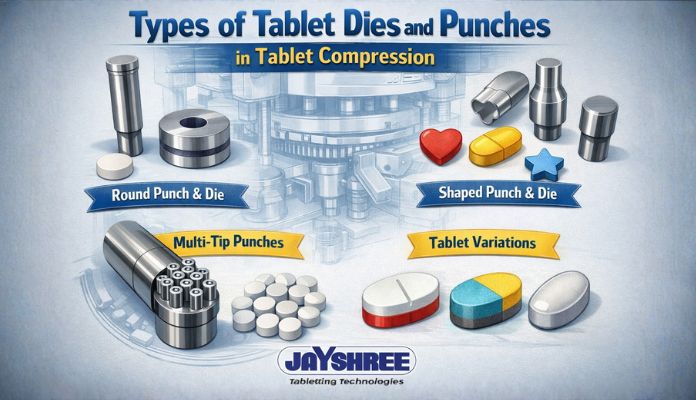
Tablet dies and punches and even tablet press tools are a part of a system that is assembled to make sure the tablet, granule, or powder tablets are of the same weight, hardness, and quality, as well as meeting the criteria for weight and hardness uniformity. It is because of the better understanding of the process of tablet punching that the pharmaceutical companies are able to decrease the variations in their product and increase their process and control the overall quality of the product.
What Is a Tablet Punching Machine?
These machines are used to compress powders or granules in order to make tablets of the same weight, size, and shape by using a controlled pressure. Raw tablet dies and tablet punches are used for this purpose.
When in operation, powder is loaded into a die cavity and compressed with two punches to create a tablet. The accuracy of the compression process affects the integrity, thickness, and overall aesthetics of the tablet.
The design of contemporary tablet punching devices aims to maximize both speed and the strict requirements of the pharmaceutical industry. With modern tablet press tools, quality and speed are no longer mutually exclusive. Manufacturers can produce thousands of quality tablets in a matter of minutes.
Key Components of a Tablet Punching Machine
A tablet punching machine consists of several mechanical components that work together to perform the compression process.
Hopper
The hopper is the pharmaceutical storage of powder or granules before entering the compression system. It feeds continuously into the die cavity and therefore, into the compression system.
Die Cavity
The die cavity is that part of the system of tablet dies and punches that controls the size, shape, and thickness of the tablet. It is the mould that powder is transformed into a tablet.
Upper and Lower Punches
Punches are the tools of precision that create the compression of powder in the die.
- The lower punch gives support to the powder in the process of filling.
- The upper punch moves down and, of course, exerts the compression.
Together, they form the tablet by applying controlled pressure.
Turret
The turret is a platform that rotates and carries several dies and punches. With each tooling station, as the turret rotates, a different operation is accomplished in the cycle of tablet manufacture.
Cam Track System
The cam mechanism allows for the precise vertical adjustments of the punches during the compression cycle, which are responsible for the proper operation of the filling, compression, and ejection sequences.
Tablet press tooling of the highest quality allows all of these parts to work together to produce tablets of uniform and reliable quality.
Step-by-Step Process of Tablet Compression
The process of tablet compression occurs in a predetermined series of operations within the tablet punching machine.
Step 1 – Powder Feeding
The granules or powder of the pharmaceutical material are introduced into the system via the hopper and begin to travel towards the die cavity.
Step 2 – Die Filling
The turret then rotates, and the die in question is positioned to the feeder system, where a controlled quantity of powder is allowed to fill the cavity of the die. The lower punch is responsible for the fill level and the overall weight of the tablet.
Step 3 – Compression Stage
After the die has been filled, the upper punch descends, and the lower punch moves to the top. The two of them compress the powder to a very high level of pressure, making it very solid and compact, and thus form a tablet.
Step 4 – Tablet Formation
The key to successfully compressing the powder is the adhesion of the particles to one another, such that the tablet possesses the required level of compactness, thickness, and strength.
Step 5 – Tablet Ejection
Once compression is complete, the upper punch retracts while the lower punch rises to remove the finished tablet from the die cavity. The tablet is then conveyed to the collection chute.
This ongoing process enables state-of-the-art systems to manufacture tablets at high speeds.
Why Tablet Dies and Punches Are Critical for Tablet Quality
The quality of tablets is highly influenced by the accuracy of the tablet dies and punches. These parts determine the tablet's shape, embossing, and the integrity of the tablet's construction.
Well-designed tooling ensures:
- Correct tablet weight
- Consistent tablet thickness
- Quality surfaces
- Clear Branding/Embossing
- Lower defect rates
The quality of tooling is crucial, as inadequate tooling can result in problems such as capping, sticking, and weight variation. Because of this, many pharmaceutical companies are selective in the tablet tooling suppliers they work with.
Types of Tablet Punching Machines Used in Pharma Manufacturing
Pharmaceutical companies may implement different tablet punching machines based on their production needs.
Single Rotary Tablet Press
Single rotary tablet presses have a single compression station and are used for small production runs, research, or lab work.
Double Rotary Tablet Press
Double rotary tablet presses have multiple tooling stations and can generate a high output of tablets in a short time. These are standard in large-scale pharmaceutical manufacturing operations.
For these machines to work effectively, they depend on quality and precision tablet press tooling, especially during high-speed operations.
Common Problems in Tablet Compression
Tablet production can be difficult even with new machines, as there are many issues when compressing.
Some issues that can arise with compressed tablets are:
- Sticking – where powder sticks to punches/dies.
- Capping – when the top layer of the tablet separates when compressed.
- Lamination – when a tablet separates into layers.
- Weight Variation – when there is not enough fill powder.
- Tool wear – as punches/dies are used, they degrade.
Using good tooling and proper machine settings can alleviate these issues.
How High-Quality Tablet Tooling Improves Production Efficiency
The right tooling makes a difference in the pharmaceutical industry.
Some of the benefits of quality tablet press tooling include:
- Increased tool lifetimes
- Less machine downtime
- Improved tablet consistency
- Increased production efficiency
- Reduced rejection rates
Companies such as Jayshree Tabletting Technologies produce high-precision-designed tooling that is meant to last throughout many cycles. Using new production methods and materials means that consistent tablet quality can be achieved even with high-speed compression.
Best Practices for Maintaining Tablet Punching Machines
To ensure tablets are of consistent quality and machines last a long time, good maintenance must be practised.
Some of these maintenance practices are:
- Regular inspection of punches and dies
- Proper cleaning of tooling components
- Monitoring compression pressure
- Lubricating moving parts
- Replacing worn tooling promptly
Manufacturers like Jayshree Tabletting Technologies offer punches and dies that are precision-engineered for reliability and consistency in harsh pharmaceutical environments.
Future Trends in Tablet Compression Technology
Tableting compression technology is developing continuously, and so is the pharmaceutical industry.
Emerging trends include:
- High-speed automated tablet presses.
- Newer toolings made out of carbide.
- Smart compression force monitoring.
- Improved coatings to punches and dies to minimise sticking.
Pharmaceutical manufacturers are able to develop their production with these innovations while abiding to the regulations and standards of the industry.
Conclusion
A tablet punching machine is one of the most important components of pharmaceutical manufacturing. All of the processes that are done must be controlled in order to ensure that the tablets are of the same quality.
Just as vital are the tablet punches, dies, and tablet press tooling for the compression phase. Improved quality tooling also boosts efficiency, reduces defect rates, and enhances manufacturing reliability.
With expertise in precision tooling solutions, companies such as Jayshree Tabletting Technologies continue to support pharmaceutical manufacturers by delivering reliable tooling designed for modern tablet production.
Frequently Asked Questions
1. What is a tablet punching machine?
A tablet punching machine is a piece of pharmaceutical equipment that uses specific dies and punches to turn powders/granules into tablets.
2. How does a tablet punching machine work?
A tablet punching machine loads the powder into a cavity of a die and uses an upper and lower punch to compress the powder, and the machine has a mechanism that continuously rotates to remove the formed tablet.
3. What are tablet dies and punches?
Tablet dies and punches are precision tools that are used to hit and form the powder into tablets during the manufacturing process.
4. Why is tablet press tooling important?
Good tablet press tooling minimizes production defects and machine downtimes and ensures that tablets are consistently of the same weight, hardness, and shape.
5. How often should tablet punches be replaced?
Tablet punches should be inspected regularly and replaced when signs of wear, surface damage, or compression defects appear.